Impact on
the Grid
Distributed
Generation is a way for end-users of electricity
to contribute to the integrity and reliability of
our electric grid. This reduces the need to
build more power plants, and lets us use our
existing resources more efficiently.
The flip-side to distributed
generation is that with more parties
participating, there must be a greater emphasis on
coordinating those parties. The traditional
model of sending electricity one way (generator to
user) requires its own level of sophistication,
but sending it back and forth between users
and generators adds another level of
complexity. The additional sources of
generation pose challenges to metering and
maintaining power quality (extra
attention
must be paid to frequency
control, voltage regulation, introducing
harmonics, etc.,).
|
| |
|
Your Energy
Manager
Topic:
Distributed Generation
|
Welcome, 
Independent
Energy Consultants, Inc. is committed to helping
its clients make well-informed
and cost-effective decisions regarding
their energy supply and consumption. We are
sending you this newsletter to help you understand
how decisions made, or not made, affect your
company's bottom line.
|
|
Augmenting
the Energy Grid
In the United States, it is easy to
take our reliable sources of electricity for
granted. Our electric grid takes energy
produced at large centrally-located power plants
and distributes it over hundreds of miles of wires
to reach its ultimate end-user. No one sees that
model going away anytime soon, but as demand grows
and technology improves we look for innovative
ways to augment the grid, and delay building new
power plants and transmission lines.
In a
previous IEC newsletter we discussed the move
towards a "smart grid,"
where new technology is spread throughout the
distribution system to better manage and
coordinate our energy usage. That topic ties
in nicely with this newsletter's discussion of
Distributed Generation.
|
|
Cooperation
Between Generators and End-Users
Distributed Generation is a way to
supplement our fleet of centrally-located power
plants by adding permanent smaller sources of
power at the location where energy will be
consumed. In doing so, we eliminate the expense
associated with a traditional transmission and
distribution system to serve that load
center. While the majority of electricity
will still come from traditional generators, there
are alternative ways to meet our energy
consumption needs.
Distributed Generation is
gaining popularity, and comes on the heels of the
success seen in Demand Response
(DR) Programs that provide temporary relief to the
grid. In a DR program, electric users agree
to reduce their usage during peak demand hours in
the summer, when the grid is at full capacity and
at the risk of brown-outs/black-outs. The grid
operators pay these users for their reduction,
because it is a better alternative than building
new power plants only to meet a few hours' worth
of demand. DR participants can reduce their
load by turning equipment off or by turning on
backup generation; the latter option is an example
of Distributed
Generation. | |
Examples
of Distributed Generation
In Distributed Generation, end users
generate some amount of electricity onsite to
offset what they consume from the grid. This
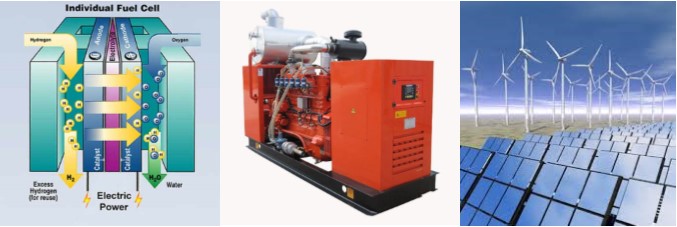
can be done by installing generation equipment,
such as:
- Solar panels, wind turbines, and
hydroelectric turbines,
- Traditional gas-powered backup
generators,
- Fuel cells that use chemical reactions
to produce electricity,
- Micro turbines. These devices
use a scaled-down version of a jet engine to
produce electricity, and can be installed at
facilities of any size.
There are also cases where facilities
can harness their own by-products to produce
electricity through "co-generation"; examples
include:
- Some facilities give off large amounts
of methane (such as waste water treatment
plants). These facilities can capture and
burn that methane to spin a
turbine.
- Some facilities produce a large amount
of heat as a by-product from their main
operation (like a steel mill). That
heat can be funneled and used to produce steam,
spin a turbine, and generate its own
electricity.
|
|
Working
Through Your Energy
Manager
There are many ways that consumers can
benefit from Distributed Generation, and
Independent Energy Consultants can help clients
begin those projects.
- As a Curtailment Service Provider
(CSP) Independent Energy Consultants can
help clients participate in Demand Response
programs. Grid operators require
participants to work through a CSP to
develop their reduction strategy, and use them
to coordinate with clients during DR
events.
- IEC licenses state-of-the-art energy
accounting software as well as real-time
energy monitoring systems that can quantify
the benefits of any energy
upgrades/retrofits. These also give
clients the ability to audit and manage their
consumption, making them more efficient and
leading to lower utility bills.
- Our experts are able to evaluate
proposals for renewable energy projects,
give feedback on the costs versus the
benefits, and make clients aware of any
show-stopping fine
print.
Many
organizations recognize the benefits of managing
energy, but may not have the time, the staff, or
the experience for those projects. Retaining
a professional energy consultant is a good way to
cut costs on your energy bills while keeping
overhead low and focusing man-hours where they are
needed. Call us at 888-862-6060 for a free
energy assessment and to see if Distributed
Generation can work for
you. |
At
Independent Energy
Consultants it's our job to help you
understand key aspects of the energy markets and
how they may impact your bottom line. We
also offer the tools to manage your energy, find
savings and protect your
budget. |
| |