Call for a Balanced Approach
The
EPA may have good intentions with this bill and we agree that each of
us has a duty to take care of our environment. We further agree that we
must look out for others, in this case our neighboring states. However,
we must be wary of the law of unintended consequences. A medicine
that does more harm than good is not an effective treatment.
Since
the establishment of the EPA on December 2, 1970, we have made great
strides in cleaning up our air and water but the cost of compliance has
been staggering.
Utility
companies and manufacturing companies have been forced to alter their
practices under EPA regulations and this has made U.S. businesses less
competitive in a global market.
Since the advent of the EPA we can
show a direct correlation to the loss of manufacturing companies and
jobs in the U.S. Products once made here that provided good livelihoods
for American workers are now produced in Mexico and overseas. Most
if not all of those countries have no comparable environmental
regulations.
We don't claim to have all the answers to the
complex social questions that arise when U.S. environmental regulations
result in lost jobs, raise the cost of products, weaken our country, and
shift our pollution problems to other countries.
What we
do know, is that promulgation of rules like the CSAPR have far reaching
impacts and there comes a tipping point when it comes to how much pain
we can bear in the unachievable pursuit of perfect air and water.
|
|
|
Your Energy Manager
Topic: Cross State Air Pollution Rule |
Welcome, 
Independent Energy Consultants, Inc. is committed to helping its clients make well-informed and cost-effective decisions regarding
their energy supply and consumption. We are sending you this newsletter
to help you understand how decisions made, or not made, affect your
company's bottom line. |
|
EPA's Objective
The Cross State Air Pollution Rule
(CSAPR) is the U.S. Environmental Protect Agency's (EPA) latest attempt
to regulate and control air pollutants; with their primary target being
fossil fuel power plants. This nationwide rule is intended to restrict
emission volume that would travel "downwind" and have a negative impact
on neighboring states. The EPA is basing this strategy on reports that
say cutting emissions will lead to better overall health and fewer
premature deaths and reduce the amount spent on healthcare nationwide.
At the end of August 2012, the "DC Circuit" (Court of Appeals for the
District of Columbia Circuit) officially vacated the legislation because
of conflict with the EPA's enforcement methods.
|
Economic Fallout
Under
the CSAPR, the utility companies within a state would be given
allowances for a certain amount of emissions and exceeding these
allowances would result in hefty penalties. On top of fines to the EPA,
any utility found in violation would have their allowance for the next
year reduced in proportion to how much they exceeded it by. The current
standards the EPA has in place have already cleaned up our air and water
but at a tremendous cost. The new standards being proposed would
be extremely difficult to meet and monitor, and another layer of
penalties for non-compliance is the last thing our struggling economy
needs. Shown below is a representation
of dollars (in millions) that would have been lost by states under the
American Clean Energy and Security act of 2009. That defeated Act
would have created a cap and trade arrangement on utility
emissions. That proposed legislation was similar to the CSAPR, and
the State Map below shows what the economic impact would have been to
achieve compliance.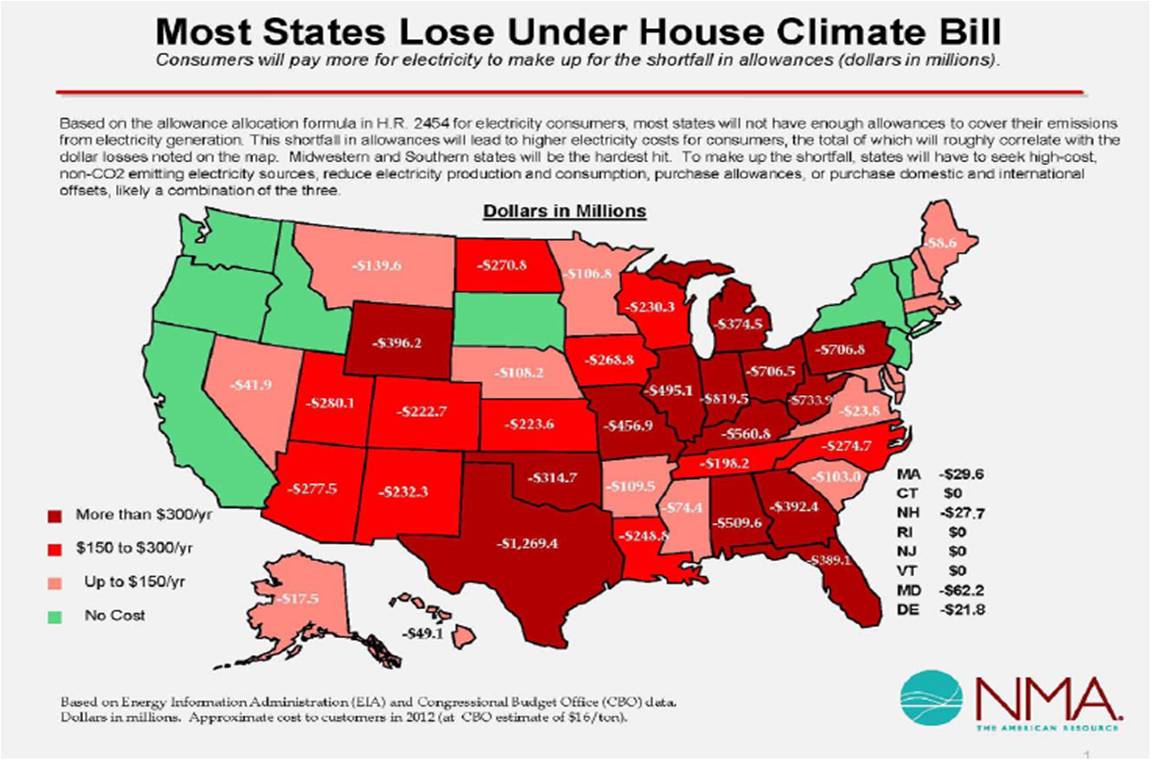 |
|
DC Circuit Court Ruling
In
recent months the CSAPR has met its share of opposition. The original
implementation date of January 1, 2012 has come and gone. In
August 2012, a 3-judge panel of the DC Circuit Court decided to vacate
the CSAPR in its entirety by a vote of 2-1. We expect the EPA to appeal
that decision and seek a ruling from the entire Court.
The
3-judge panel sited the EPA as overstepping its authority on two counts.
First, the EPA tried to impose unrealistic reduction requirements that
went beyond what the rule actually called for. Second, once the EPA
determined requirements for a state they began setting up their own
implementation plans, without giving the states a chance to respond and
meet requirements on their own. In effect, the states were expected to
do too much in too short a time and had to do so on someone else's
terms. For this reason, the DC circuit ruled (p.7)
that the EPA had "departed from its consistent prior approach" and
"violated the Act." With this rule vacated, the EPA will continue to
enforce the CAIR (Clean Air Interstate Rule), the legislation that CSAPR
was intended to replace.
At Independent Energy Consultants, we strive to keep ourselves and our clients informed on energy market issues that could effect your business.
|
 |
|
|


